The Brown School has turned out to be a very good school. I have enjoyed going there twice a week and observing the students and helping Mrs. Flower. Recently, I noticed that the teacher assesses how well students perform by how much they are paying attention. I’ve also noticed that those students who don’t pay a lot of attention to the lessons tend to ask a lot of questions about the lesson. I’ve experienced this and ask the students if they were paying attention. If they say they were, I would generally ask them base questions about the lesson. Students that tell me they weren’t really paying attention is really frustrating. It seems that some of these kids are sent to school to be babysat, and that’s disturbing. Some of the kids in the classroom are very disruptive, and they are typically the students that don’t pay attention. While there are many students in the class that DO pay attention, sometimes its understandable that they have questions. How exactly do you assess a student’s progress when you see them pay attention to the lesson, work on the assignment given, and yet, still struggle to understand the task? Is it easier for the teacher to respond to the linguistic, ethnic, and sociocultural characteristics of the students? Regardless of the cultural diversity in the school/classroom, political agencies still enter, according to Shor. He would argue that what’s taught in these culturally diverse classrooms depends on the socio-economic aspects of the region. Shor would also argue that mass education of students has become infamous for its increasing number of low motivated students. It seems that these days, teachers are “teaching to the test” and not making sure that students fully understand the material. Assessing students is almost impossible unless the teacher instills a sense of competition in his/her classroom. Now, using this logic, can students be assessed in their native language, if its not English? Goldenberg points out that a lot of research points to literacy and other skills and knowledge transfers across languages. Also, using this “transfer of information” is it possible for students to use other modes for which to understand and learn different material? Students are capable of using technology and language in order to learn.
Saturday, November 28, 2009

Sunday, October 25, 2009
Prompt #2
Having gone to my school, the Brown School, and observe the classroom and the teacher, Mrs. Flower, I've seen that most of the students are rambunctious and don't sit still for too long. This is a 4th grade class, but it seems like it is a kindergarten class. The students have a real hard time sitting still, and Mrs. Flower and myself have to constantly tell them to quiet down. Mrs. Flower has a system that she uses where she will count to 5, and stay on a number until all of the students would have their fingers up at 1,2,3...5. There are some students in this system who are quiet right away, while it would take others a couple of seconds to understand what was going on. My role in this classroom is to help during the science period of the day. I help put the experiments together and then pass out the materials to the students. After myself and Mrs. Flower explain the experiment to the students, I then walk around and ask students questions to help them along in their observations. I do this in order to get answers from the students and get their views on the experiments and what is going on.
According to Infoworks, 61% of the school is Hispanic, 23% White, 13% African American and 3% Asian. To me, this is a very diverse school because of the almost overwhelming Hispanic culture, whereas the next closest group is Whites. Even more astounding to me is that 88% of the students do not recieve some form of ESL learning, which means that most of the students don't need assistance. also, this school is slightly above the state average in Math, Reading and Writing. In Writing, this school is 20 points above the state average, which is really good. I'm pretty sure that there is an embodied cultural capital in this school, because it would seem that the students are well aware of the socialization in the schools. The classroom is set up in groups of 4 students, where each group is diversified, and the students work well together, because they see the need to work together. Mrs. Flower's class is diverse because there is a large majority of Hispanic students, as well as African American students. The class only consists of maybe 4 white students and 2-3 Asian students.
According to Infoworks, 61% of the school is Hispanic, 23% White, 13% African American and 3% Asian. To me, this is a very diverse school because of the almost overwhelming Hispanic culture, whereas the next closest group is Whites. Even more astounding to me is that 88% of the students do not recieve some form of ESL learning, which means that most of the students don't need assistance. also, this school is slightly above the state average in Math, Reading and Writing. In Writing, this school is 20 points above the state average, which is really good. I'm pretty sure that there is an embodied cultural capital in this school, because it would seem that the students are well aware of the socialization in the schools. The classroom is set up in groups of 4 students, where each group is diversified, and the students work well together, because they see the need to work together. Mrs. Flower's class is diverse because there is a large majority of Hispanic students, as well as African American students. The class only consists of maybe 4 white students and 2-3 Asian students.
Monday, September 21, 2009
My First Day of Service Learning
So today, I had my first day of the service learning portion of FNED, and suffice it to say, it was a good first experience. Although, I was anxious at first, partly due to the fact that i had never been in an inner-city school, I actually enjoyed it. The neighborhood was a mix of Hispanic and African-American cultures, which was different for me because I grew up in a predominately white town. Driving to the school, I noticed that most, if not all of the buildings on the road were labeled in Spanish or English. I noticed that there were many Hispanic stores and restaurants. The school itself, however, was nothing like I had imagined. It looked pretty new, and had a nice layout. After checking in at the main office, I made my way up the 3 flights of stairs to the classroom. Still a little nervous and anxious, i went into the room. I met the teacher, and she introduced me to the class. The class was very diverse. The classroom as well as the school "feel" like they truly want to help the children learn.
Wednesday, September 16, 2009
My First Blog-Intro
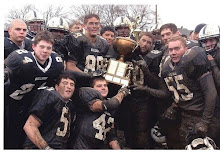
Hey, what's up all? I'm Chris, and I'm in FNED 346 as an Elementary Education major with a concentration in Social Studies. The plan is to get my Middle School endoresment but you never know what's in the future. I coach PeeWee football back home in Westerly and love every minute. My semester is going good so far. I'm really looking forward to starting my SLP.
Subscribe to:
Posts (Atom)